When the questionnaire and live exposure disagree, you find out first.
Three-layer vendor scoring on every record: Business Criticality, Assessed Posture, Live External Exposure, with an explicit flag the moment they stop agreeing.
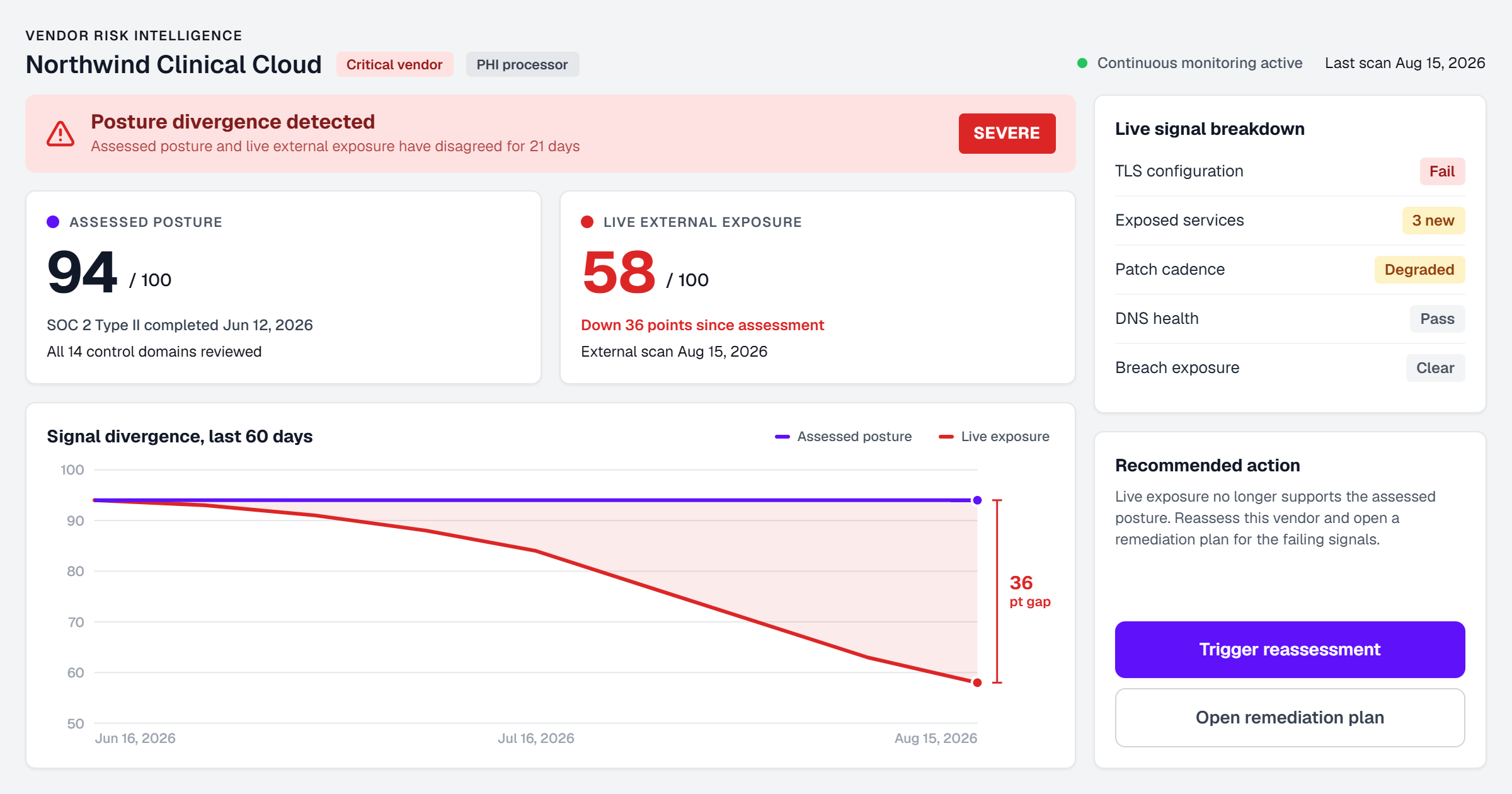
One vendor. Three independent signals.
Most platforms collapse vendor risk into a single number. We keep three because they tell different stories.
Business Criticality
Set at onboarding. How critical is this vendor to your business processes? What data do they touch? What's the blast radius if they fail?
Assessed Posture
From completed security questionnaires + supporting evidence + reviewer validation. What the vendor claims about their security.
Live External Exposure
From continuous external monitoring: exposed services, certificate health, patch hygiene, known incidents. What's actually true today.
When assessed and live stop agreeing, the platform acts.
- 1
Continuous comparison
On every external scan tick, we compute the gap between assessed posture and live exposure. Vendors with stable posture stay quiet.
- 2
Severity tiering
Gaps above threshold are tiered Minor (informational), Moderate (review recommended), or Severe (immediate action).
- 3
Auto-update + auto-task
Severe events update the parent risk record (status, score, treatment plan) and auto-generate a remediation task assigned to the vendor owner.
- 4
Reviewer validates
Owner sees the divergence, the data behind it, and Effy's recommended action. They approve, override, or escalate. AuditLog captures every step.
The intersection no other platform sits at.
Some platforms have assessed posture. Others have live exposure. None have both on a unified data model with an explicit divergence flag.
Category comparison reflects publicly available product information as of May 2026. We've kept this table conservative. Feature availability changes; the architectural pattern of running assessed and live signals on a unified data model is the moat.
The architecture has to come first.
Posture Divergence Detection isn't a feature you add. It's a consequence of running internal posture, vendor posture, and live external signals on a single data model. Most platforms in this space were built before AI mattered, with vendor risk bolted on after a SOC 2 product. Their architecture treats vendor risk as a separate module, with separate data, separate scoring, separate workflows.
Catching up means rebuilding the data model. That's not a quarterly roadmap item. It's a 12 to 18 month rewrite, while continuing to ship for existing customers. By the time competitors get there, divergence detection will be a year of refinement, customer cycles, and audit-room reps ahead.
We're publishing this openly because the moat isn't the idea. The moat is the architecture. Anyone can copy the term. Replicating the workflow takes the unified data model that started on day one.
Catch the problem months beforethe next questionnaire would.
Annual reassessment finds last year's vendor. Divergence detection finds today's.
- Reassess the vendors that changed, not all of themSeverity tiers (Minor, Moderate, Severe) turn a 300-vendor program into a short list of who needs a reassessment now.
- Walk into the audit with one coherent storyAssessed posture, live exposure, the drift event, the analyst decision, and the reassessment sit on one timeline your auditor can follow.
- Stop paying for two disconnected viewsQuestionnaire tooling tells you what a vendor claimed. A ratings feed tells you what the internet sees. Neither can tell you they disagree.
- Defend the decision, not just the scoreEvery flag carries its reason and every clearance carries a rationale, written to the audit log at the moment it happened.
Illustrative outcomes, stated as built-to-deliver targets. ThirdSentry is pre-GA and these are not realized customer results.
See it fire on a real vendor.
30-minute walkthrough. We'll pull a live external scan on a sample vendor and show you what divergence looks like in context.