Continuous vendor monitoring that spots real drift.
Live exposure on every vendor, compared against the posture they reported. Material change surfaces in days, not at next year's reassessment.
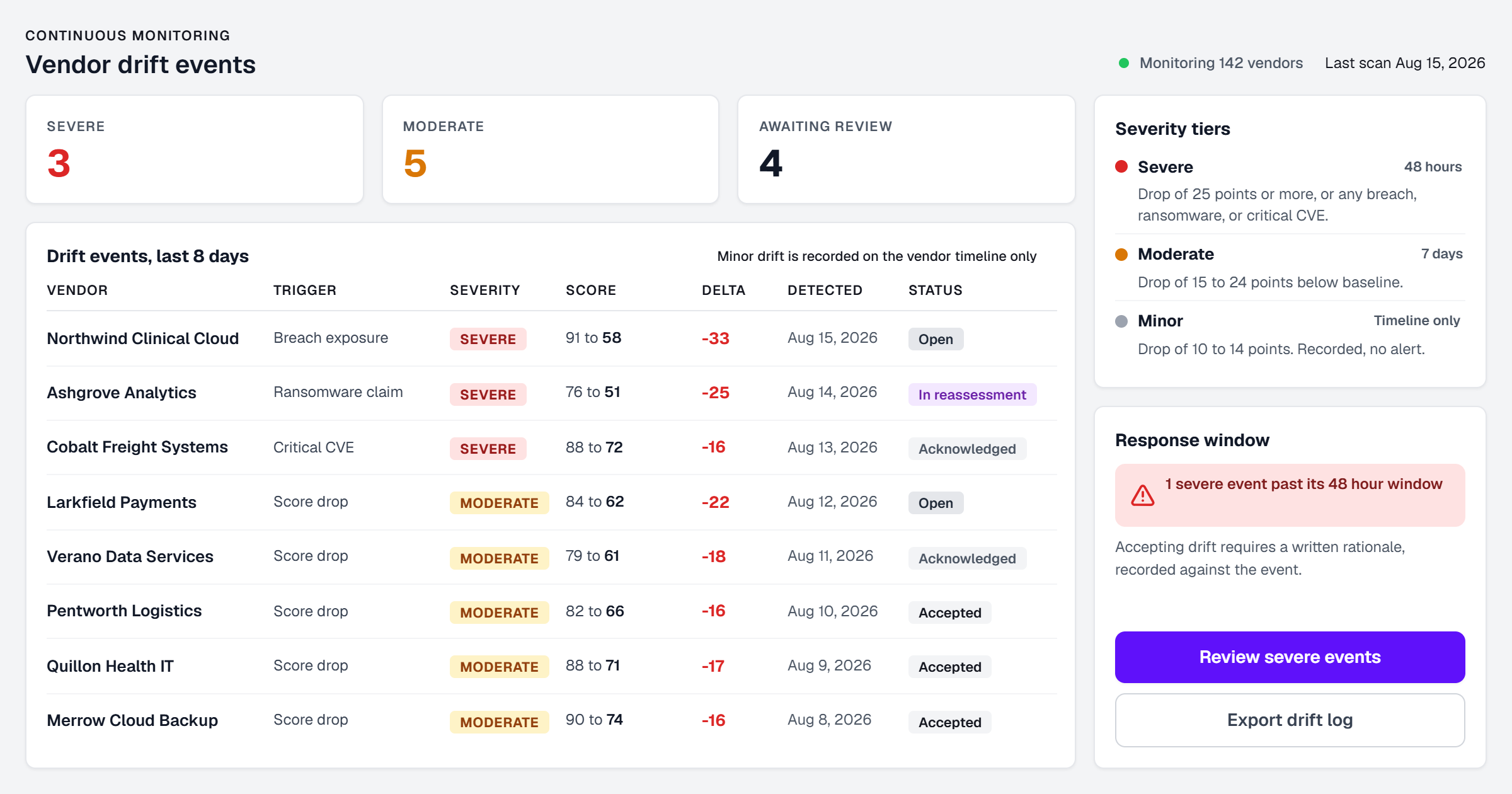
Monitoring that compares, not just collects.
Continuous external signal collection
External scanning runs on every vendor with no vendor-side setup. Signals land on the vendor record itself.
- External exposure scanned continuously per vendor
- No agents or vendor-side installation required
- Signals land on the vendor risk record, not a silo
Exposure compared against reported posture
Live exposure, compared against what the assessment claimed. That comparison is the alert worth waking up for.
- Live exposure reconciled against assessed posture
- Divergence flagged, not just score movement
- Both signals on one vendor data model
Thresholds that control alert noise
Minor movement is logged silently. Alerts fire only past the thresholds you set.
- Configurable drift thresholds per signal
- Minor drift logged, not alerted
- Alerts reserved for material change
Severity tiering: Minor, Moderate, Severe
Every event is tiered before it reaches a human, weighted by business criticality. All of it preserved for audit.
- Three-tier severity model on every drift event
- Business criticality weights the escalation path
- Full event history retained on the vendor record
Baselines reset only on completed assessments
Baselines reset only on a completed assessment, never on a quiet score recovery.
- Baseline anchored to completed assessments
- Score recovery never erases a drift event
- Every baseline change is audit-logged
Incident to reassessment in one workflow
Trigger a targeted reassessment straight from the drift event. Everything stays on one vendor record.
- Targeted reassessment triggered from a drift event
- Remediation tasks generated on material divergence
- Parent risk record updates automatically
Three steps from setup to value.
Turn monitoring on
Enable monitoring on any vendor. Scanning starts immediately, anchored to their last completed assessment.
Let thresholds do the filtering
Drift accumulates silently until it crosses your thresholds, tiered Minor, Moderate, or Severe.
Act on divergence, not noise
The risk record updates, a tiered alert fires, and you remediate or reassess from the same record.